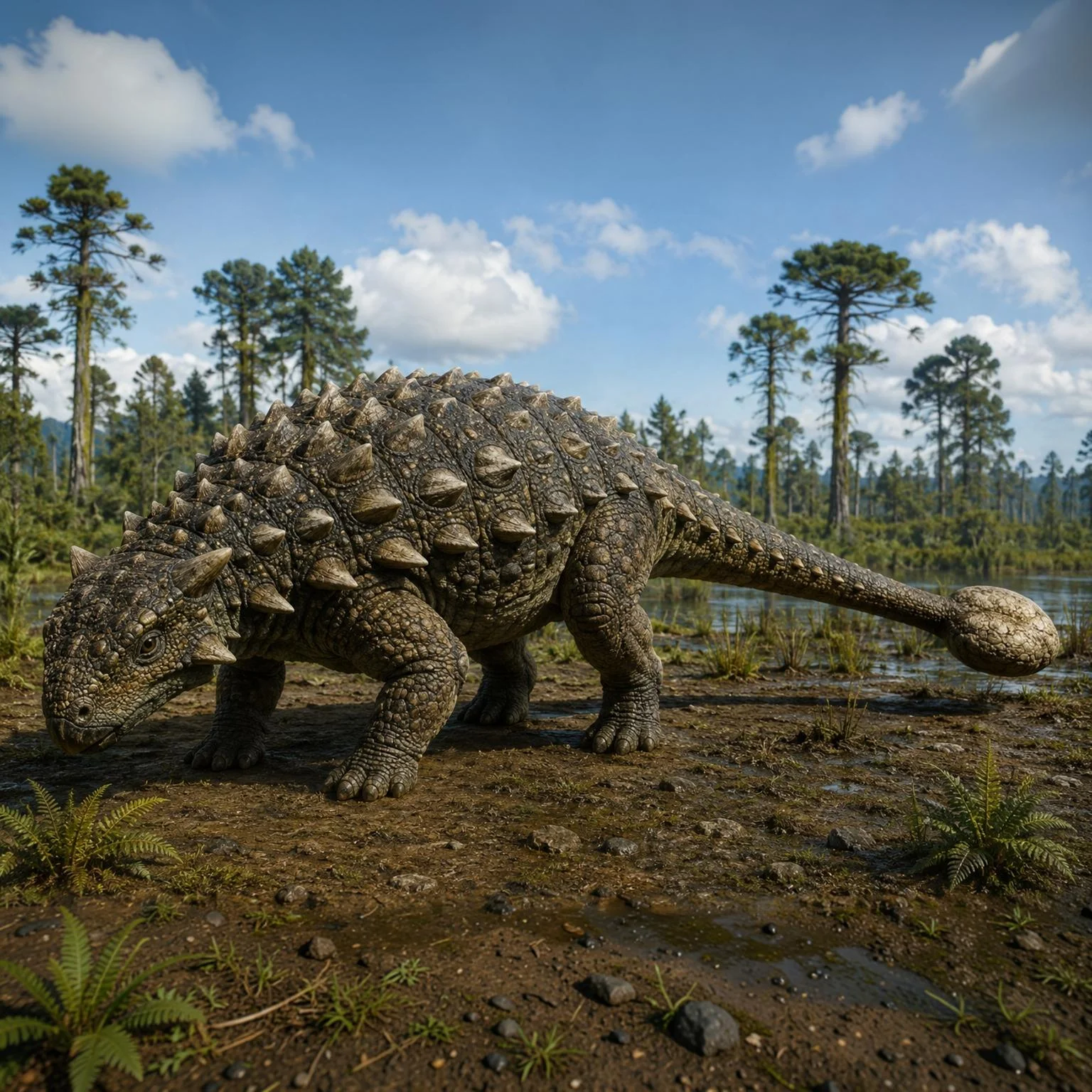
The most heavily armoured dinosaur that ever walked the Earth. Every inch of its upper body was encased in fused bone plates called osteoderms, and its tail club could shatter the leg bones of a T-Rex with a single swing. पृथ्वी पर चलने वाला सबसे भारी कवचधारी डायनासोर। इसके ऊपरी शरीर का हर इंच ऑस्टियोडर्म नामक जुड़ी हड्डी की प्लेटों में बंद था।
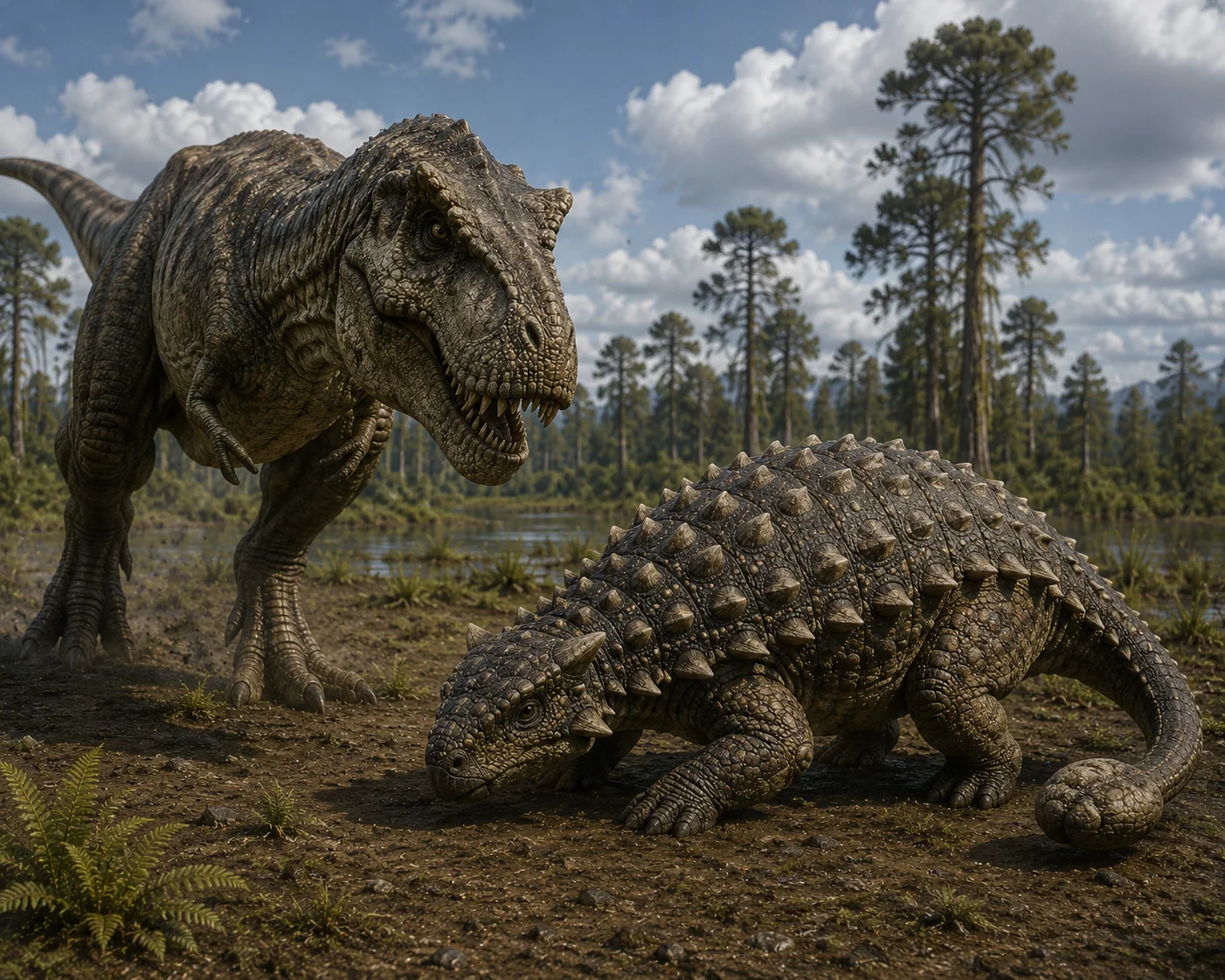
Ankylosaurus was a slow-moving, ground-hugging tank of the Cretaceous. Its entire upper body — back, flanks, and even eyelids — was covered in osteoderms: bony plates embedded in the skin and fused together into a continuous shield. Unlike other armoured dinosaurs, the armour on Ankylosaurus was not attached to its skeleton but was embedded in the skin, making it highly flexible. It roamed the forests and floodplains of western North America, likely living a solitary or loosely social life. Its wide, low-slung body made it almost impossible to flip over — its primary defence posture was to crouch flat to the ground, presenting only armoured surfaces to any attacker.
एंकिलोसॉरस क्रेटेशियस का धीमे चलने वाला, ज़मीन से चिपका टैंक था। इसका पूरा ऊपरी शरीर — पीठ, किनारे, यहाँ तक कि पलकें — ऑस्टियोडर्म से ढका था। इसका चौड़ा, नीचे झुका शरीर इसे पलटना लगभग असंभव बनाता था।
Ankylosaurus was a ground-level grazer and low-browser. Its wide, broad beak was designed for cropping low vegetation — ferns, flowering plants, and ground-level shrubs. Despite its massive 8-tonne body, its teeth were surprisingly small and leaf-shaped, capable of processing only soft plant material. Its enormous barrel-shaped body housed an extraordinarily large gut with a long fermentation chamber to extract maximum nutrition from low-quality plant material through slow bacterial fermentation.
एंकिलोसॉरस एक ज़मीनी चराने वाला था। इसकी चौड़ी चोंच निम्न वनस्पति काटने के लिए डिज़ाइन थी। इसके दाँत आश्चर्यजनक रूप से छोटे और पत्ती के आकार के थे।
Ankylosaurus's extraordinary armour was the most effective passive defence system of any known dinosaur. With its entire upper body protected by fused bone plates and its lethal tail club for active defence, healthy adults had few serious predatory threats even from T-Rex. Growth ring analysis suggests a lifespan of 30–40 years. The most common cause of natural death was likely dental failure — when the small, leaf-shaped teeth wore down, the animal could no longer process vegetation effectively.
एंकिलोसॉरस का असाधारण कवच किसी भी ज्ञात डायनासोर की सबसे प्रभावी निष्क्रिय रक्षा प्रणाली थी। स्वस्थ वयस्कों के पास टी-रेक्स से भी कम गंभीर शिकारी खतरे थे।
Ankylosaurus had one of the most extraordinary body designs of any animal ever. Its back was covered in dense, oval bone plates (osteoderms) up to 50cm wide, with rows of conical spikes along the flanks. The skin between the plates was thick and leathery. The tail ended in a massive, fused-bone club formed from an enlarged tail tip — essentially a solid bone wrecking ball. The head was also heavily armoured with fused bony plates covering the skull.
एंकिलोसॉरस का किसी भी जानवर के सबसे असाधारण शरीर डिज़ाइनों में से एक था। इसकी पीठ 50 सेमी तक चौड़ी घनी, अंडाकार हड्डी की प्लेटों से ढकी थी। पूँछ एक विशाल, जुड़ी हड्डी की गदा पर समाप्त होती थी।
A fully interactive 3D reconstruction of Ankylosaurus is being developed. This scientifically accurate model will feature its armour plating, iconic tail club, and realistic animation. Check back soon! एंकिलोसॉरस का एक पूरी तरह से इंटरैक्टिव 3D पुनर्निर्माण विकसित किया जा रहा है। यह वैज्ञानिक रूप से सटीक मॉडल जल्द ही उपलब्ध होगा!
Multiple Ankylosaurus specimens including partial skulls and armour plates have been found. The fossil sites often show Ankylosaurus and T-Rex remains in the same formation — direct evidence they shared the same ecosystem.
हेल क्रीक फॉर्मेशन — एंकिलोसॉरस के आंशिक नमूने।
The type specimen of Ankylosaurus was found here in 1906 by Barnum Brown. This specimen established the genus and provided the first understanding of the tail club's structure.
यहाँ 1906 में एंकिलोसॉरस का प्रकार नमूना पाया गया।
The sounds of Ankylosaurus are still a matter of active scientific research. Its heavily armoured head with complex nasal passages may have acted as a resonating chamber, producing low-frequency sounds for communication. Based on comparisons with living archosaurs, it likely produced closed-mouth rumbling calls and low hisses.
एंकिलोसॉरस की ध्वनियाँ अभी भी सक्रिय वैज्ञानिक शोध का विषय हैं। इसके जटिल नासिका मार्ग प्रतिध्वनि कक्ष के रूप में काम कर सकते थे।
Coming Soon — Roar sounds will be added when audio files are sourced. The sounds of this dinosaur are still a matter of active scientific research — no direct recordings exist.
आने वाले समय में ध्वनि फ़ाइलें जोड़ी जाएंगी। इस डायनासोर की ध्वनियाँ अभी भी सक्रिय वैज्ञानिक शोध का विषय हैं।
🔮 Future Scope — Roar audio files will be added here once they are sourced and ready. The exact vocalisations of dinosaurs remain an active area of scientific research. 🔮 भविष्य की योजना — दहाड़ ऑडियो फ़ाइलें यहाँ जोड़ी जाएंगी जब वे तैयार होंगी। डायनासोरों की सटीक ध्वनियाँ वैज्ञानिक शोध का एक सक्रिय क्षेत्र बनी हुई हैं।
Ankylosaurus's armour protected IT, not you. Being near it is the danger — the tail club swings in a wide arc at ground level, exactly where a human would be standing. You'd never see it coming.
एंकिलोसॉरस का कवच उसकी रक्षा करता था, आपकी नहीं। इसके पास होना खतरनाक है — पूँछ की गदा ज़मीन के स्तर पर चौड़े चाप में झूलती है।
At 10m long and 8 tonnes, Ankylosaurus's body weight makes any accidental collision potentially fatal. It can't see things directly below its heavily armoured head very well — you could be trampled without it ever noticing.
10 मीटर लंबे और 8 टन पर, एंकिलोसॉरस का शरीर भार किसी भी आकस्मिक टकराव को संभावित रूप से घातक बनाता है।
Ankylosaurus was among the very last dinosaurs alive, perishing in the Chicxulub mass extinction event 66 million years ago. Despite its extraordinary physical defences — the most effective armour of any known dinosaur — no amount of physical protection could withstand the global ecosystem collapse that followed the asteroid impact. As a large herbivore, Ankylosaurus was entirely dependent on surviving plant populations, and when photosynthesis failed globally, its food supply vanished within weeks. एंकिलोसॉरस जीवित अंतिम डायनासोरों में से था, 6.6 करोड़ वर्ष पूर्व विलुप्त हुआ। इसके असाधारण भौतिक बचाव के बावजूद, वैश्विक पारितंत्र पतन का सामना कोई भी कवच नहीं कर सकता था।