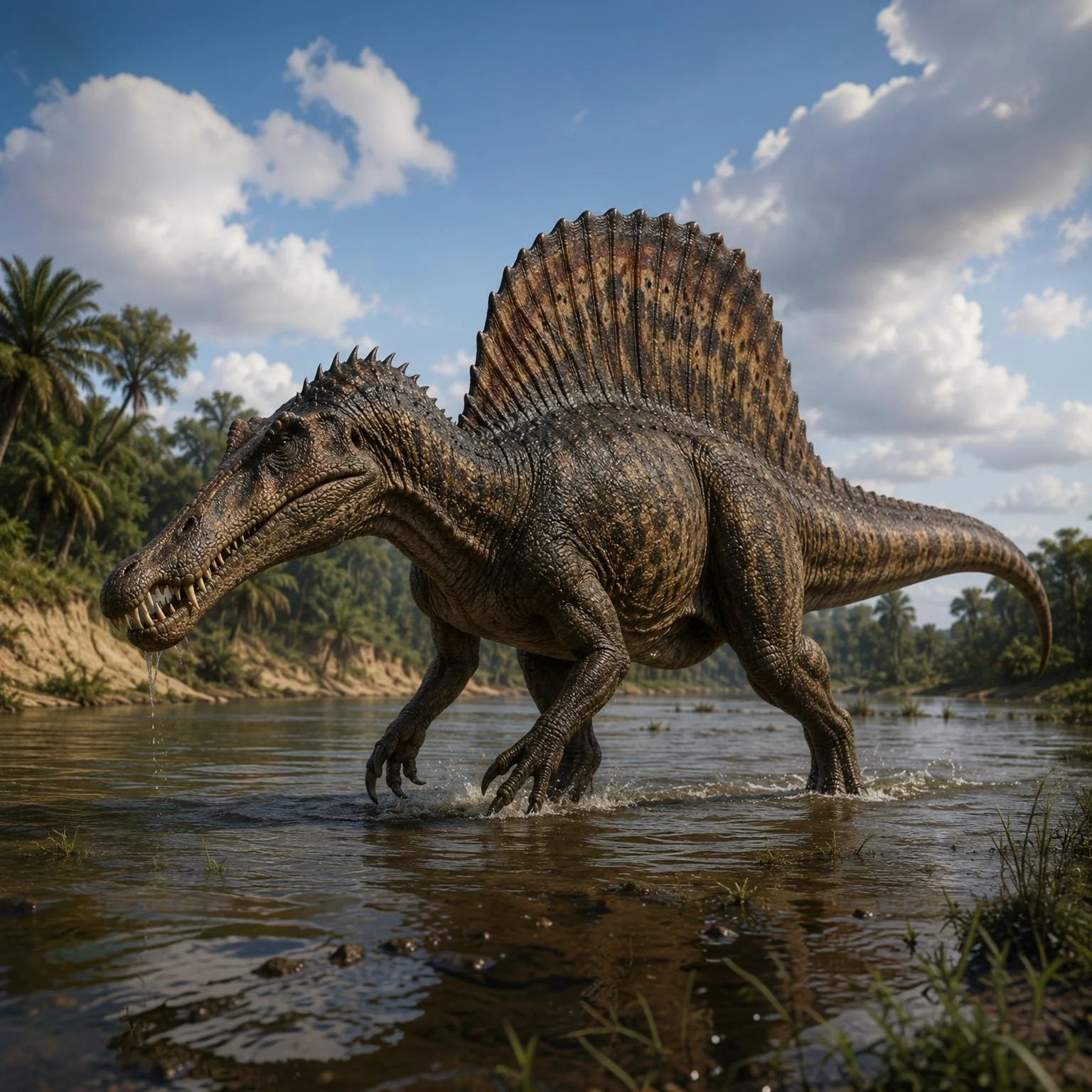
The largest carnivorous dinosaur ever discovered — bigger than T-Rex. Spinosaurus was the world's first known semi-aquatic dinosaur, prowling the vast river systems of ancient North Africa like a colossal crocodile. अब तक खोजा गया सबसे बड़ा मांसाहारी डायनासोर — टी-रेक्स से बड़ा। स्पाइनोसॉरस दुनिया का पहला ज्ञात अर्ध-जलीय डायनासोर था।
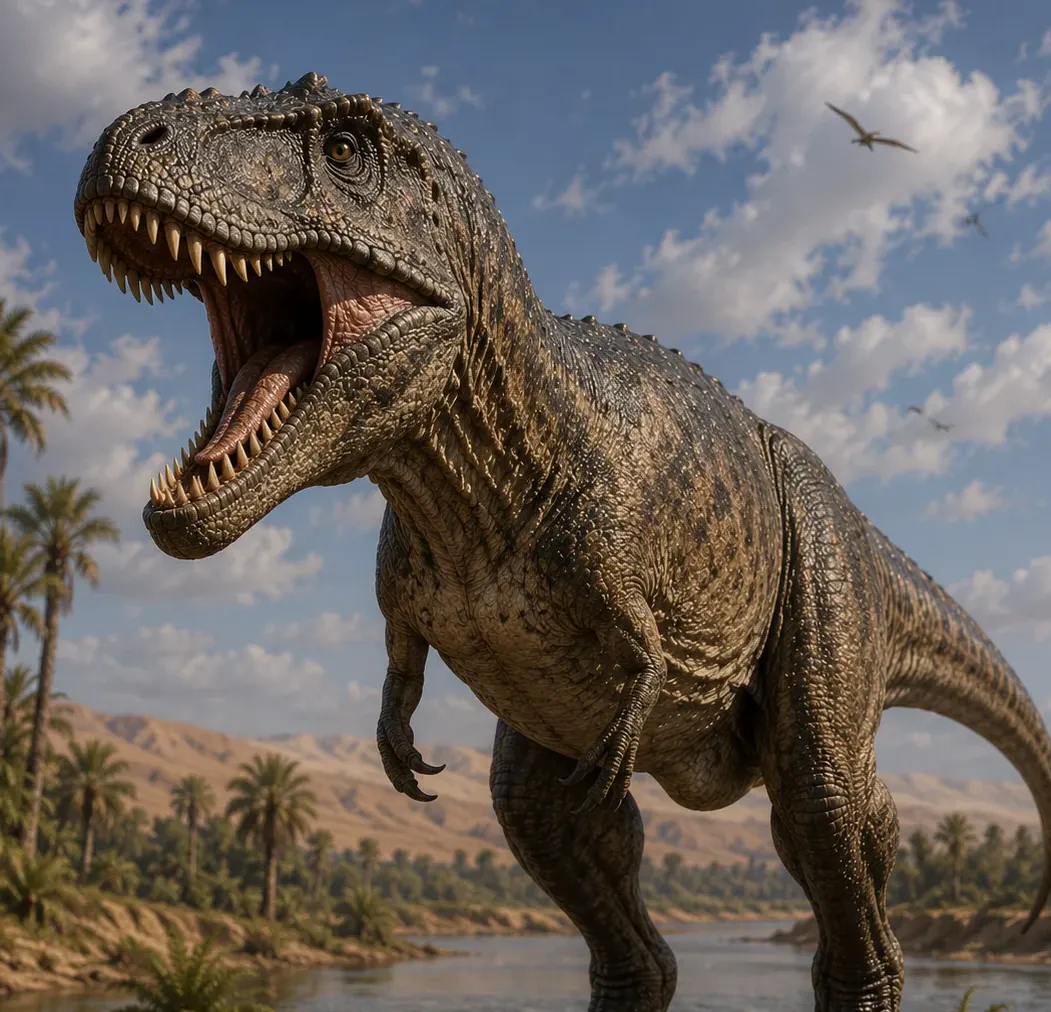
Spinosaurus was a revolutionary discovery — the world's first confirmed semi-aquatic dinosaur. It lived along the vast river systems and deltas of what is now North Africa (Morocco, Egypt, Niger) approximately 95–100 million years ago. Its nostrils were positioned high on its skull, like a crocodile, allowing it to breathe while mostly submerged. Its bones were unusually dense — unlike most dinosaurs — giving it negative buoyancy for controlled swimming underwater. The iconic 1.65-metre-tall sail on its back was supported by elongated neural spines and may have functioned as a thermoregulator, a fat-storage hump, or a species-recognition display.
स्पाइनोसॉरस एक क्रांतिकारी खोज थी — दुनिया का पहला पुष्ट अर्ध-जलीय डायनासोर। यह आज के उत्तरी अफ्रीका के विशाल नदी तंत्रों के साथ रहता था। इसकी नासिकाएँ खोपड़ी पर ऊँची थीं, मगरमच्छ की तरह।
Spinosaurus was primarily a fish specialist. Its long, narrow, crocodile-like snout was lined with conical teeth — ideal for gripping slippery fish rather than tearing meat. Pressure-sensitive receptors in the snout tip (similar to crocodiles) could detect water disturbances from moving fish without needing to see them. It likely waded in shallow water and struck with lightning speed, capable of catching enormous fish: the rivers of Cretaceous North Africa contained giant coelacanths, enormous lungfish (up to 3 metres), and massive Mawsonia specimens that few other predators could handle.
स्पाइनोसॉरस मुख्य रूप से मछली विशेषज्ञ था। इसकी लंबी, संकरी, मगरमच्छ जैसी थूथन शंकु के आकार के दाँतों से भरी थी — फिसलन भरी मछलियों को पकड़ने के लिए आदर्श।
Spinosaurus disappeared around 93–95 million years ago — significantly before the famous end-Cretaceous extinction. Scientists believe a major geological event caused the vast river systems of North Africa to dry up dramatically during this period, eliminating Spinosaurus's semi-aquatic habitat and specialised fish prey. As an apex predator entirely adapted to a very specific ecological niche, it could not adapt when that niche collapsed.
स्पाइनोसॉरस लगभग 9.3–9.5 करोड़ वर्ष पूर्व गायब हो गया — प्रसिद्ध क्रेटेशियस-अंत विनाश से काफी पहले। वैज्ञानिकों का मानना है कि उत्तरी अफ्रीका की नदी प्रणालियाँ सूख गईं।
Spinosaurus was one of the most distinctive-looking dinosaurs ever to exist. Its entire body plan was unlike any other known predator: elongated crocodile-like skull, dense heavy bones for aquatic use, short hind legs with webbed-foot adaptations for swimming, and the extraordinary 1.65m sail of elongated neural spines. Recent research suggests it may have been quadrupedal in the water, paddling like an otter, rather than bipedal on land. Its colouration is unknown, but a dark, countershaded crocodilian pattern is considered most likely.
स्पाइनोसॉरस अब तक के सबसे विशिष्ट दिखने वाले डायनासोरों में से एक था। लंबी मगरमच्छ जैसी खोपड़ी, जल उपयोग के लिए घनी भारी हड्डियाँ, और असाधारण 1.65 मीटर पाल।
A fully interactive 3D reconstruction of Spinosaurus is being developed. This scientifically accurate model will feature its distinctive sail, aquatic adaptations, and realistic animation. Check back soon! स्पाइनोसॉरस का एक पूरी तरह से इंटरैक्टिव 3D पुनर्निर्माण विकसित किया जा रहा है। यह वैज्ञानिक रूप से सटीक मॉडल जल्द ही उपलब्ध होगा!
The original Spinosaurus discovery site. Ernst Stromer discovered the first Spinosaurus remains here in 1912, but they were tragically destroyed in a WWII bombing raid on Munich in 1944. Later expeditions recovered more material.
मिस्र — मूल स्पाइनोसॉरस खोज स्थल। अर्न्स्ट स्ट्रोमर ने 1912 में यहाँ पहले अवशेष खोजे।
The most productive Spinosaurus site in the world. Dozens of teeth, vertebrae, and limb bones have been recovered. The 2014 discovery of a partial skeleton here revolutionised our understanding of Spinosaurus as semi-aquatic.
मोरक्को — दुनिया में सबसे उत्पादक स्पाइनोसॉरस स्थल।
Spinosaurus-related teeth and bones have been found here alongside the famous Sarcosuchus (the 'SuperCroc') — providing a vivid picture of the dangerous river ecosystem they shared.
नाइजर — यहाँ स्पाइनोसॉरस से संबंधित दाँत और हड्डियाँ मिली हैं।
The sounds of Spinosaurus are still a matter of active scientific research. As a semi-aquatic hunter of fish, it may have produced low hissing and rumbling sounds similar to modern crocodilians — closed-mouth resonant calls that travelled well across water surfaces. Its large size suggests it could produce exceptionally low-frequency sounds that would carry kilometres across the African waterways it inhabited.
स्पाइनोसॉरस की ध्वनियाँ अभी भी सक्रिय वैज्ञानिक शोध का विषय हैं। एक अर्ध-जलीय मछली शिकारी के रूप में, यह आधुनिक मगरमच्छों के समान कम हिसिंग और गड़गड़ाहट की ध्वनियाँ उत्पन्न कर सकता था।
Coming Soon — Roar sounds will be added when audio files are sourced. The sounds of this dinosaur are still a matter of active scientific research — no direct recordings exist.
आने वाले समय में ध्वनि फ़ाइलें जोड़ी जाएंगी। इस डायनासोर की ध्वनियाँ अभी भी सक्रिय वैज्ञानिक शोध का विषय हैं।
🔮 Future Scope — Roar audio files will be added here once they are sourced and ready. The exact vocalisations of dinosaurs remain an active area of scientific research. 🔮 भविष्य की योजना — दहाड़ ऑडियो फ़ाइलें यहाँ जोड़ी जाएंगी जब वे तैयार होंगी। डायनासोरों की सटीक ध्वनियाँ वैज्ञानिक शोध का एक सक्रिय क्षेत्र बनी हुई हैं।
In an aquatic encounter, Spinosaurus is unbeatable. It is 15m long, outswims you easily, can detect your movement through pressure receptors before it even sees you, and can strike from below like a crocodile. Death would be certain and rapid.
जलीय मुठभेड़ में, स्पाइनोसॉरस अजेय है। यह 15 मीटर लंबा है, आसानी से तेज़ तैरता है, और नीचे से मगरमच्छ की तरह प्रहार कर सकता है।
Even on land, Spinosaurus's conical teeth — evolved to grip large wriggling fish — would pierce through a human body with terrifying efficiency. Its neck was long and powerful enough to deliver repeated strikes.
ज़मीन पर भी, स्पाइनोसॉरस के शंकु के आकार के दाँत एक मानव शरीर को भयावह दक्षता से छेद देंगे।
Spinosaurus disappeared around 93–95 million years ago — long before the Chicxulub asteroid. A major climatic event caused the vast river systems of Cretaceous North Africa to dry up, eliminating the semi-aquatic habitat and enormous fish populations that Spinosaurus depended on. As a hyper-specialised predator, it could not adapt. It was the victim of ecological collapse rather than a mass extinction event. स्पाइनोसॉरस लगभग 9.3–9.5 करोड़ वर्ष पूर्व गायब हो गया — चिक्सुलब क्षुद्रग्रह से बहुत पहले। एक बड़ी जलवायु घटना ने नदी तंत्रों को सुखा दिया।