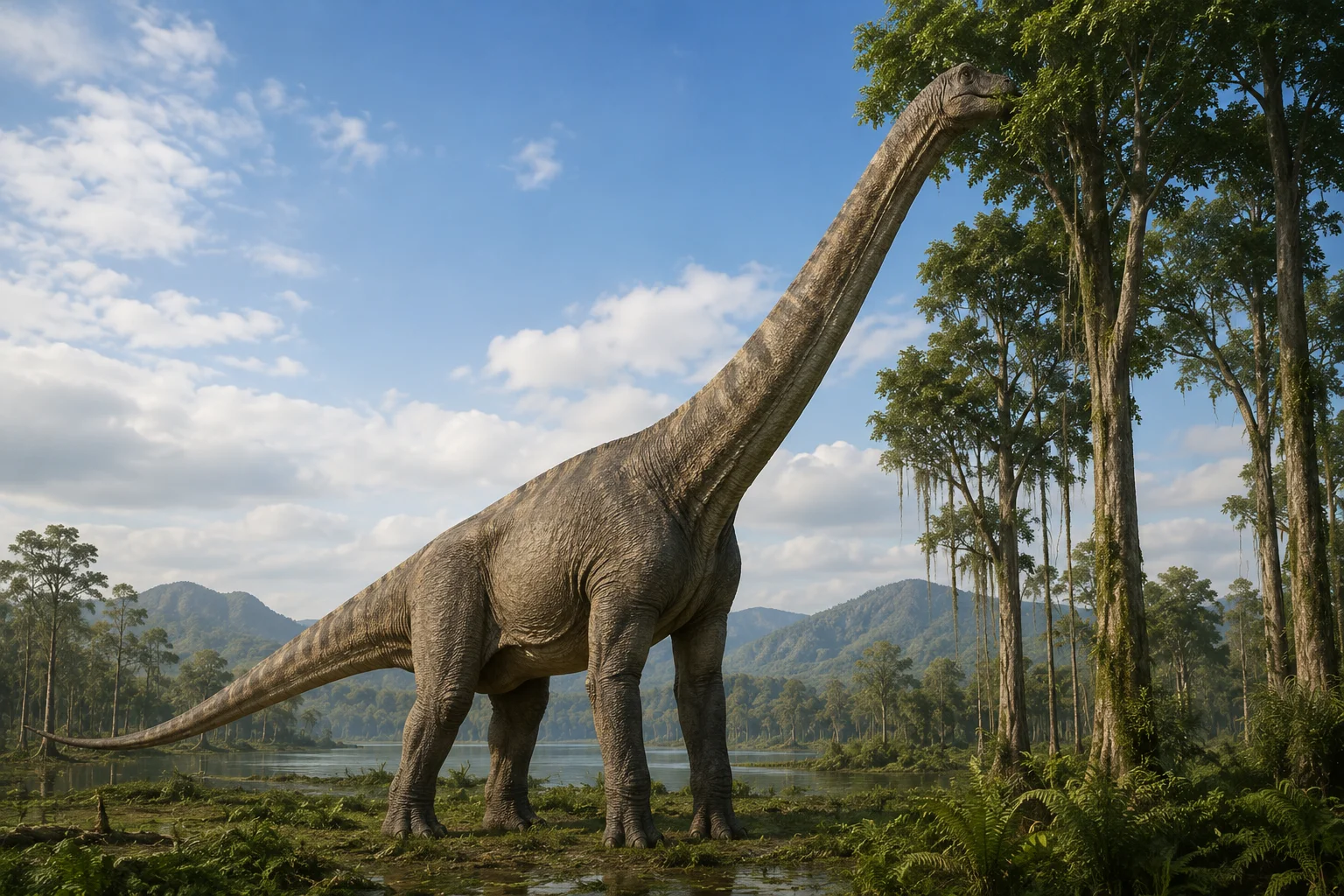
The tallest dinosaur known from complete remains. At 13 metres high, Brachiosaurus could look into a 4th-floor window. Its heart was the size of a car engine, pumping blood up a 9-metre neck. पूर्ण अवशेषों से ज्ञात सबसे ऊँचा डायनासोर। 13 मीटर ऊँचाई पर, ब्रैकियोसॉरस चौथी मंजिल की खिड़की में देख सकता था।
Brachiosaurus lived in open woodland savannahs and forested valleys of what is now North America and Africa. Unlike other sauropods, it had longer front legs than back legs — giving it a permanently upward-tilted posture like a living giraffe, built for reaching the high forest canopy. It likely moved in herds for protection, migrating seasonally as food sources moved. Baby Brachiosaurus hatched from eggs the size of melons and grew at extraordinary rates — from 10 kg hatchlings to 56-tonne adults.
ब्रैकियोसॉरस आज के उत्तरी अमेरिका और अफ्रीका के खुले वनस्पति सवाना में रहता था। अन्य सॉरोपॉड के विपरीत, इसकी अगली टाँगें पिछली टाँगों से लंबी थीं — जिराफ की तरह स्थायी रूप से ऊपर की ओर झुकी मुद्रा।
Brachiosaurus was a high-browser, using its enormously long neck to reach the canopy of 30-metre conifers that other herbivores couldn't access at all — giving it exclusive access to the highest food tier. It needed approximately 400 kg of plant material every day. It swallowed food whole without chewing — using gastroliths (stomach stones) to grind food internally. Its peg-like front teeth were designed purely for raking leaves from branches, not for chewing.
ब्रैकियोसॉरस एक ऊँचा चरने वाला था, 30 मीटर ऊँचे कोनिफर के शिखर तक पहुँचने के लिए अपनी लंबी गर्दन का उपयोग करता था। इसे प्रतिदिन लगभग 400 किलो पौधे सामग्री की आवश्यकता थी।
Large sauropods like Brachiosaurus likely had very long lifespans — perhaps 80–100 years — similar to elephants and large tortoises today. Their sheer size meant that once fully grown, they had virtually no natural predators. Their slow metabolism allowed extremely efficient energy use. Growth ring analysis in fossilised bones suggests most natural deaths resulted from dental failure — when their teeth wore out, they could no longer process food efficiently.
ब्रैकियोसॉरस जैसे बड़े सॉरोपॉड संभवतः 80–100 वर्षों का जीवन जीते थे। पूरी तरह बड़े होने पर, उनके पास व्यावहारिक रूप से कोई प्राकृतिक शिकारी नहीं था।
Brachiosaurus had an unmistakable silhouette — a vast barrel-shaped body, four columnar legs, an enormously long neck angled upward at roughly 45 degrees, a small head with a blunt snout, and a relatively short tail. Fossilised skin impressions suggest it had a mosaic of scales in varying sizes, likely grey-green or brown for camouflage in woodland environments. The nostrils were positioned high on its skull, above the eyes, which led early palaeontologists to mistakenly believe it lived in water.
ब्रैकियोसॉरस का एक अचूक सिल्हूट था — एक विशाल बैरल के आकार का शरीर, चार स्तंभ जैसी टाँगें, और एक असाधारण लंबी गर्दन लगभग 45 डिग्री ऊपर की ओर।
A fully interactive 3D reconstruction of Brachiosaurus is being developed. This scientifically accurate model will feature its towering neck, barrel-shaped body, and realistic animation. Check back soon! ब्रैकियोसॉरस का एक पूरी तरह से इंटरैक्टिव 3D पुनर्निर्माण विकसित किया जा रहा है। यह वैज्ञानिक रूप से सटीक मॉडल जल्द ही उपलब्ध होगा!
The primary Brachiosaurus fossil zone in North America. The famous 'Brachiosaurus altithorax' holotype was found here in 1900 by Elmer Riggs.
मोरिसन फॉर्मेशन — उत्तरी अमेरिका में प्राथमिक ब्रैकियोसॉरस जीवाश्म क्षेत्र।
African Brachiosaurus specimens (Giraffatitan) were found here in early 20th century expeditions. The Berlin Museum of Natural History displays the world's largest mounted dinosaur skeleton from this site.
तंज़ानिया — अफ्रीकी ब्रैकियोसॉरस नमूने यहाँ पाए गए।
The sounds of Brachiosaurus are still a matter of active scientific research. Its enormous body cavities and long neck may have functioned as resonating chambers for producing deep, low-frequency calls — possibly infrasonic (below human hearing range) — similar to how elephants use infrasound for long-distance communication across forests.
ब्रैकियोसॉरस की ध्वनियाँ अभी भी सक्रिय वैज्ञानिक शोध का विषय हैं। इसकी विशाल शरीर गुहाएँ और लंबी गर्दन गहरी, कम आवृत्ति पुकारें उत्पन्न करने के लिए प्रतिध्वनि कक्ष के रूप में काम कर सकती थीं।
Coming Soon — Roar sounds will be added when audio files are sourced. The sounds of this dinosaur are still a matter of active scientific research — no direct recordings exist.
आने वाले समय में ध्वनि फ़ाइलें जोड़ी जाएंगी। इस डायनासोर की ध्वनियाँ अभी भी सक्रिय वैज्ञानिक शोध का विषय हैं।
🔮 Future Scope — Roar audio files will be added here once they are sourced and ready. The exact vocalisations of dinosaurs remain an active area of scientific research. 🔮 भविष्य की योजना — दहाड़ ऑडियो फ़ाइलें यहाँ जोड़ी जाएंगी जब वे तैयार होंगी। डायनासोरों की सटीक ध्वनियाँ वैज्ञानिक शोध का एक सक्रिय क्षेत्र बनी हुई हैं।
A Brachiosaurus foot weighed more than 2 tonnes. Its stride covered 4+ metres. In a herd, the risk of being accidentally crushed underfoot is essentially 100%. Even a stationary Brachiosaurus poses a lethal threat to anything at ground level.
ब्रैकियोसॉरस के पैर का वजन 2 टन से अधिक था। झुंड में, गलती से कुचले जाने का जोखिम अनिवार्य रूप से 100% है।
Unlike carnivorous dinosaurs, Brachiosaurus only attacked if threatened. If you kept a large distance and made no threatening movements, it might ignore you entirely — hence the lower death rate than predatory dinosaurs.
मांसाहारी डायनासोर के विपरीत, ब्रैकियोसॉरस केवल खतरा होने पर हमला करता था।
Brachiosaurus disappeared near the end of the Jurassic Period, around 145–150 million years ago — long before the famous Cretaceous extinction. The cause is debated, but changing climate, sea level rise flooding their habitats, and competition from newer sauropod lineages most likely contributed. ब्रैकियोसॉरस जुरासिक काल के अंत के पास, लगभग 14.5–15 करोड़ वर्ष पूर्व गायब हो गया — प्रसिद्ध क्रेटेशियस विनाश से बहुत पहले।